
Scoped API keys let you control exactly which meetings and data an integration can access. Use scoped keys when setting up new integrations or tightening access for existing ones.
Each scoped APII key you create has a specific scope that defines precisely which meetings and related data it can access. This lets you:
- Give a third-party integration only the data it genuinely needs.
- Issue a key tied to a specific user's meetings for personal automations like Zapier.
- Prevent private recordings from ever being exposed through a key.
- Reserve broad org-wide access for the integrations that specifically require it.
Note: API keys created before scoped keys were introduced are tagged as Legacy. They continue to work exactly as before but appear as read-only in the Developer page. See the Legacy keys section below for details.
This article is useful for admins who need to enforce data boundaries, protect private recordings, or limit third-party tools to only the data they need.
Before you begin
|
Key sections
- The three scopes: Choose the right access level for your integration
- Legacy keys: Understand how older keys work and when to migrate
- Create a scoped API keys: Step-by-step to generate a new scoped key
- Manage API keys: View, rename, revoke, or regenerate existing keys
The three scopes
When creating a key you choose one of four scopes. As a rule of thumb: pick the scope that grants the minimum access the integration needs.
|
Scope |
Tied to |
What it can access |
Best for |
|---|---|---|---|
|
User – limited access |
One user |
That user’s non-private meetings only. Private meetings are always excluded. |
Tools that should never receive private recordings. |
|
User – full access |
One user |
Everything that user can see in Avoma, including their private meetings. |
Integrations that need to act as a specific person. |
|
Organization – limited access |
Org-wide |
All non-private meetings across the org. Private meetings are excluded. |
Reporting or analytics tools that should only use shared data. |
Scope details
1. User – limited access
The key is tied to one designated user (the owner). It returns only that user’s meetings, and private meetings are always excluded.
- Owner required: You assign a specific user when creating this key.
- Private meetings: Excluded. The integration will never see recordings marked as private.
- Use when: A tool should work on behalf of one user but must never access private recordings — for example, a Zapier automation that only processes shared calls.
2. User – full access
The key is tied to one designated user. It returns everything that user can see in Avoma, including private meetings.
- Owner required: You assign a specific user when creating this key.
- Private meetings: Included. The integration can access all meetings the user is entitled to view.
- Use when: An integration needs to fully replicate what a specific user can access — for example, a personal AI assistant or analytics workflow.
3. Organization – limited access
The key has org-wide access but is limited to non-private meetings. It is not tied to a single user.
- Owner: The admin who created the key is recorded as owner for audit purposes. Data access is org-wide, not user-specific.
- Private meetings: Excluded. The integration will only ever see non-private org meetings.
- Use when: You want to connect a reporting tool, BI dashboard, or analytics platform to shared org data without ever exposing private recordings.
Important: Organization – limited access is the highest-privilege scope. Only issue it when the integration specifically requires access to organization wide meetings (excluding the private meetings). If you are unsure, start with User – limited access.
Legacy keys
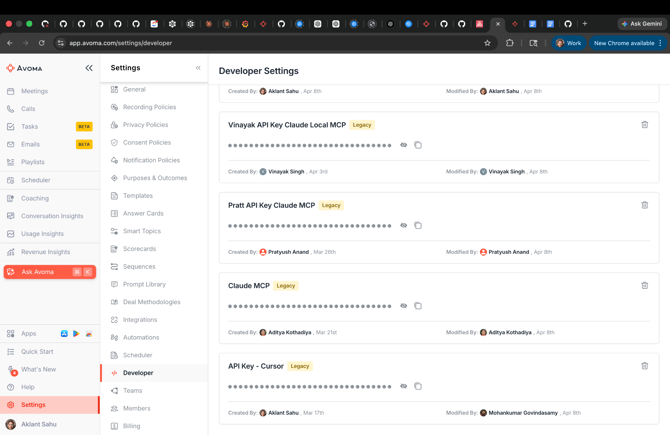
API keys created before scoped keys were introduced are automatically tagged as Legacy in the Developer page.
- They keep working: Legacy keys are not disabled. Existing integrations using them continue to run without any changes required.
- They are read-only in the Developer page: You can view and revoke legacy keys, but you cannot assign a scope or owner to them.
- They retain full org access: Legacy keys behave exactly as they did before — they can read all meetings in your organization.
- They cannot be converted: There is no in-place migration to a scoped key. To restrict access, create a new key with the scope you need, update your integration to use it, then revoke the legacy key when you’re ready.
Constraints and limits
|
Constraint |
Details |
|---|---|
|
Scope is permanent |
A key’s scope cannot be changed after creation. To use a different scope, create a new key and revoke the old one. |
|
Issued-to user is permanent |
For user-scoped keys, the “Issued to” user cannot be reassigned after creation. Create a new key to change the owner. |
|
10 keys per org |
Your organization can hold up to 10 API keys at a time. Revoking a key frees a slot immediately. |
|
Admins only |
Only org admins can create, view, or revoke keys. Non-admin users do not have access to the Developer page. |
Step-by-step
Create a scoped API key
Note: Only org admins can create, view, and revoke API keys.
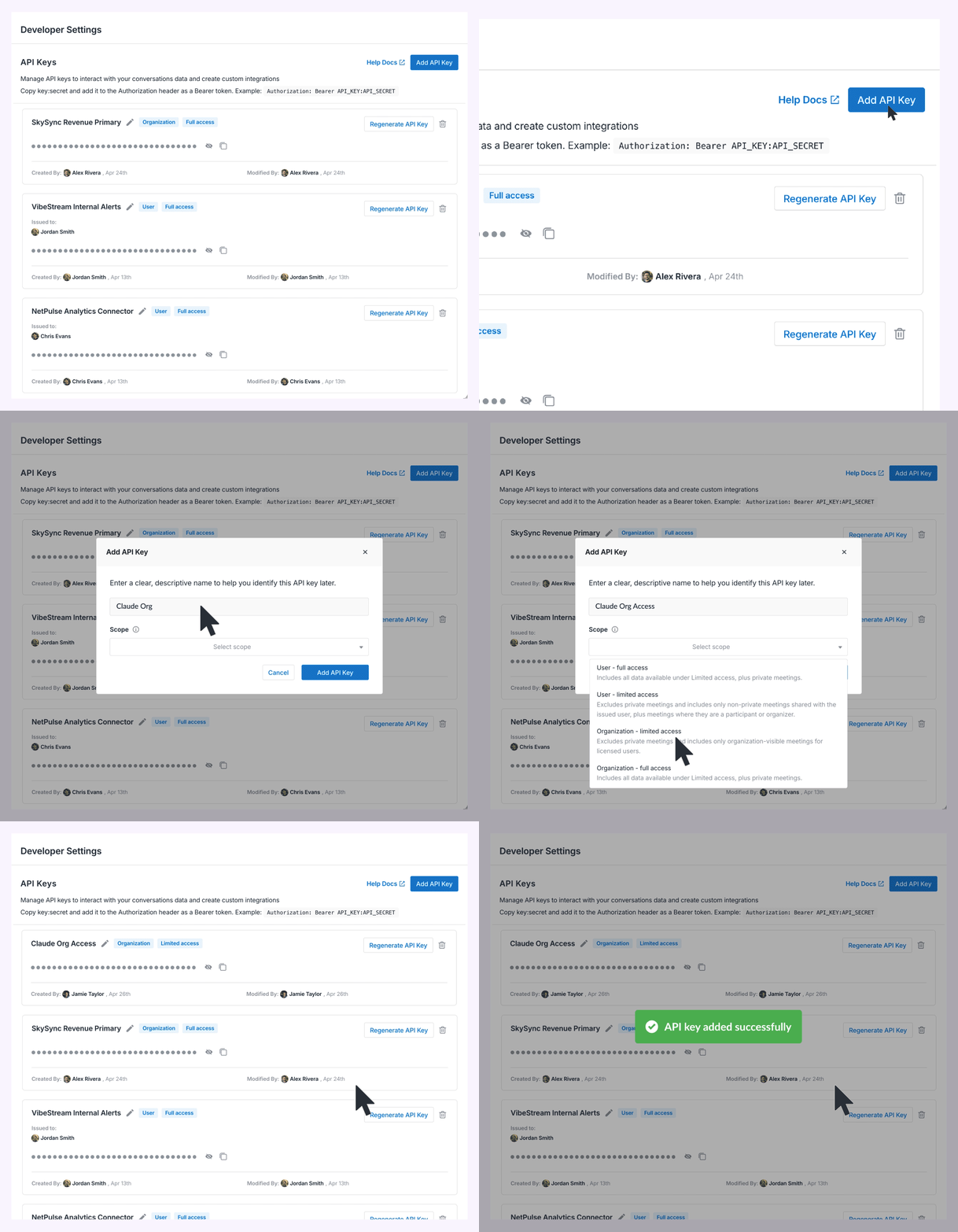
- Go to Settings → Organization → Developer.
- Click Add API Key.
- Enter a descriptive Name (e.g., “Zapier – CS Team” or “BI Dashboard Readonly”).
- Select a Scope from the dropdown:
- User – limited access
- User – full access
- Organization – limited access
- If you selected a User scope, choose the user in the Issued to field.
- Click Create.
- Copy the full key string (CLIENT_KEY:CLIENT_SECRET) and store it securely.
Manage existing keys
-
View all active API keys, including their scope, owner, and creation date, in Settings → Organization → Developer.
- To rename a key, find it in the list, click the pencil icon, and update the label. Renaming does not affect the key's credentials or any active integrations using it.
- To delete a key, find it in the list and click on the Delete icon. This is permanent and immediately revokes access for any integration using that key.
- To regenerate a key, find it in the list and click on the Regenerate API key button.
Note: Identify keys marked as Legacy, and revoke (delete) any keys that are no longer needed from the Developer page.
Tips
- Issue one key per integration or team rather than sharing a single key across tools. This makes it easier to rotate or revoke access without a broad impact.
- Label keys clearly from the start. Vague names like Key 1 become hard to manage as integrations grow.
- If you expect a sudden spike in API usage, such as a large batch of meetings in a short period, notify the Avoma engineering team in advance so they can accommodate the load.
Troubleshooting and FAQs
What should I do if an API key is compromised?
Regenerate it immediately — this issues a new credential without affecting other keys or losing the key name.
- Go to Settings → Organization → Developer
- Find the compromised key and click Regenerate
- Copy the new credential string and update it in any integrations that were using the old key
Alternatively, you can delete the key and create a new one — but regenerating keeps the same name and is faster.
Can I change the scope of a key after it’s been created?
No. Scope is fixed at creation and cannot be modified. Create a new key with the scope you need, update your integration to use it, then revoke the original.
Can I reassign the “Issued to” user on a user-scoped key?
No. For User – limited access and User – full access keys, the assigned user is permanent. If the user leaves or you need different access, create a new user-scoped key for the relevant user.
What happens if the user on a user-scoped key is deactivated?
API requests using that key will return an error. The key is not automatically deleted — an admin should revoke it manually to keep the key list clean.
My integration is still using a legacy key. Do I need to do anything now?
No immediate action is required. Legacy keys keep working as normal. Whenever you are ready to move to tighter access control, create a new scoped key, update the integration, and revoke the legacy key.
We’ve reached the 10-key limit. What do I do?
Review the key list and revoke any keys that are no longer in active use. Each revoked key frees a slot immediately. We are actively exploring options to raise or remove this limit in a future update.
Who can see the API key values in the Developer page?
Any org admin can open the Developer page and view key strings. If a key is compromised, revoke it immediately from Settings → Organization → Developer and create a replacement.
What's next
- Getting started with Avoma's API — Overview of what the API can do and how to make your first request.
- Avoma API reference — Full technical documentation including endpoints, authentication details, and rate limits.
Recap
Your API keys are created, named, and stored securely. Each integration now has its own credential, so you can manage access cleanly as your stack grows.
Need help? Reach out at help@avoma.com.