
This article covers what Avoma's Deal Health parameter is, how it's calculated, where to find it on the Deal page, and how to use it to spot at-risk deals earlier. It also answers common questions about deal risk scores and deal risk analysis tools.
In this article:
- What is the Deal Health Score in Avoma?
- How is Deal Health Score calculated in Avoma?
- Understanding your Deal Health in Avoma
- Why you can trust Avoma's deal risk score
- How to use Avoma's Deal Health Score
|
Before you begin
|
What is Deal Health Score in Avoma?
Deal Health Score is Avoma's deal risk score for every opportunity in your pipeline. It helps sales teams quickly understand deal health by continuously analyzing evidence throughout the sales process, rather than relying on a static checklist or manual updates.
Avoma evaluates multiple dimensions of deal execution, including customer engagement, buying process progression, stakeholder involvement, sales execution, CRM activity, and conversational insights to estimate the likelihood of a successful outcome.
Avoma's proprietary AI model continuously incorporates new information from meetings, emails, CRM updates, and other deal activities. As a deal evolves, its Deal Health Score is automatically refreshed to reflect the latest evidence.
What is deal risk analysis?
Deal risk analysis is the process of evaluating an active sales opportunity to determine how likely it is to close, stall, or be lost. It typically weighs signals such as stakeholder engagement, meeting cadence, buying-process progression, and CRM activity.
Avoma automates deal risk analysis for every opportunity in your CRM. Instead of a rep or manager manually reviewing a deal to assess its risk, Avoma's AI continuously scores each opportunity and updates that score as new evidence arrives from meetings, emails, and CRM changes.
How is Avoma's Deal Health Score calculated?
Avoma's Deal Health Score is calculated by a proprietary AI model that continuously analyzes multiple dimensions of deal execution, such as customer engagement, buying process progression, and CRM activity, among others, using evidence from every meeting, email, and CRM update tied to the opportunity.
The model weighs this evidence to produce a 0–100 risk score and a Low, Medium, or High deal risk classification, and it automatically re-scores the deal whenever new activity comes in.
Because sales organizations differ, no single input determines the score. Avoma's AI weighs the overall pattern of evidence rather than applying a fixed formula, and the score updates automatically as new evidence arrives. You don't need to manually refresh or recalculate it.
Understanding Deal Health in Avoma
Every opportunity in Avoma includes a comprehensive health assessment that helps you quickly understand its current state and how it has evolved over time. You'll find this on the Deal page, under the Deal Health tab, alongside the Risk score and Deal risk fields.
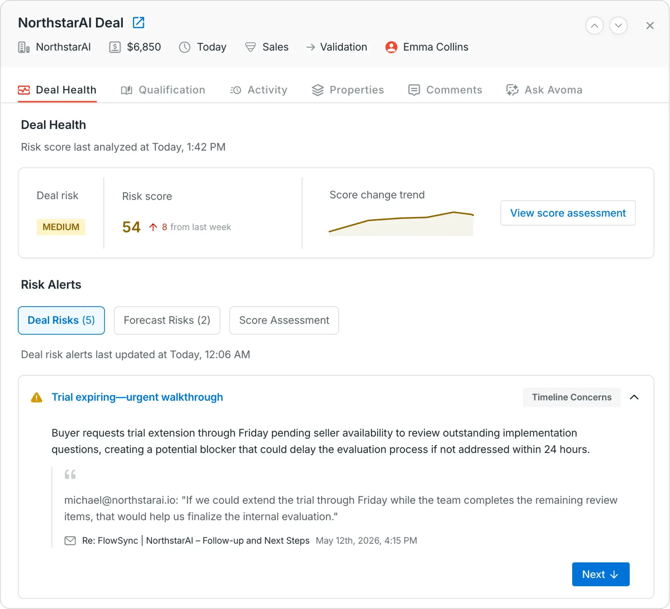 Deal page → Deal Health tab — showing the Deal risk level, Risk score, Score change trend, and a View score assessment button
Risk score (0–100)
Each deal receives a dynamic Risk score between 0 and 100, representing its overall health based on the available evidence. Higher scores indicate healthier opportunities, while lower scores suggest increasing risk and areas that may require attention.
Deal risk
In addition to the numeric Risk score, every opportunity is classified into one of three Deal risk levels, the core output of Avoma's deal risk analysis:
- Low — The deal is progressing as expected with strong buying signals.
- Medium — The deal shows mixed signals and may require additional attention.
- High — The AI has identified multiple indicators suggesting the deal is at risk of stalling or being lost.
Score change trend
Deal health isn't static. Avoma tracks how the Risk score changes over time, helping you identify whether a deal is gaining momentum, remaining stable, or becoming riskier. This makes it easier to spot deteriorating deals before they become pipeline surprises.
Score assessment
Every Risk score is accompanied by an AI-generated assessment, accessible via the View score assessment button, explaining the primary factors influencing the score.
Instead of presenting a black-box prediction, Avoma highlights the key positive and negative factors contributing to the current assessment, enabling sellers and managers to understand what needs attention.
Assessment Timeline
Avoma maintains a timeline of health assessments so you can see how the deal has evolved throughout its lifecycle. As new meetings occur, CRM records change, or customer engagement shifts, the assessment is updated to reflect the latest evidence, providing a historical view of the opportunity's momentum.
Example: An opportunity might show a Risk score of 56 and a Medium Deal risk classification. Its Score assessment could highlight positive factors, such as frequent, multi-threaded meetings with the buying committee, alongside negative factors, like a stalled buying process or several weeks without a CRM update.
Instead of guessing why a deal looks uncertain, the rep or manager can see exactly which factors are pulling the score down and act on them directly.
Why you can trust Avoma's deal risk score
Avoma's Deal Health Score is designed around three core principles:
- Accuracy — The model evaluates a broad range of evidence throughout the customer journey rather than relying on any single activity or data point.
- Explainability — Every score is supported by observable deal activity, helping sellers and managers understand what contributes to a healthy opportunity or increases its risk.
- Continuous assessment — The score is automatically refreshed as new meetings, emails, and CRM activity come in, so it always reflects the deal's current state rather than a point-in-time snapshot.
Because every sales organization is different, no single signal determines a deal's health.
Instead, Avoma's AI considers the overall pattern of customer interactions, deal progression, and sales execution to produce a balanced assessment.
How to use Avoma's Deal Health Score
Use Avoma's deal risk score to:
- Prioritize opportunities that need immediate attention.
- Identify at-risk deals before they stall or slip.
- Monitor whether deal health is improving or declining over time.
- Understand the key factors influencing each deal's health.
- Coach sellers with objective, evidence-based insights.
- Improve pipeline reviews with a consistent, continuously updated deal risk analysis.
Deal risk tools: frequently asked questions
What is a deal risk score?
A deal risk score is a numeric or categorical rating that estimates how likely a sales opportunity is to close successfully versus stall or fall through. In Avoma, this is called the Deal Health Score — a 0–100 score paired with a Low, Medium, or High risk classification.
What's the difference between a Deal Health Score and deal risk analysis?
Deal risk analysis is the underlying process — evaluating engagement, stakeholder involvement, CRM activity, and conversation data to judge a deal's likelihood of success. The Deal Health Score is Avoma's output of that analysis: a single, continuously updated score and risk level for each opportunity.
Which platforms offer deal risk analytics?
Deal risk analytics is offered across a few categories of sales technology: revenue and conversation intelligence platforms that analyze calls, emails, and meetings; pipeline execution and forecasting platforms; and CRM-native forecasting add-ons. Avoma's approach combines conversation intelligence, CRM data, and buyer engagement signals into a single Deal Health Score, rather than requiring separate tools for call analysis and pipeline risk scoring.
What are deal risk tools?
Deal risk tools are software features or platforms that flag opportunities likely to stall, slip, or be lost, typically by combining signals such as stakeholder engagement, meeting cadence, buying-process progression, and CRM activity into a single risk indicator. Avoma's deal risk tool is the Deal Health Score, which scores every opportunity from 0–100 and classifies it as Low, Medium, or High risk based on continuously updated evidence from meetings, emails, and CRM data.
Related articles
If you have any questions, contact our team at help@avoma.com