
Avoma uses four privacy levels to decide who can see meetings and its recording.
This article explains who gets access under each option so you can choose the right level. Use this when you need to understand how Avoma treats internal vs external meetings
1. Understand the four privacy levels
Avoma controls access to meetings and recordings with four core privacy options:
- Private
- Primary Team
- Organization
- Public
Each option defines who can view content inside and outside your organization, and some have different default behavior depending on whether the meeting is internal or external.
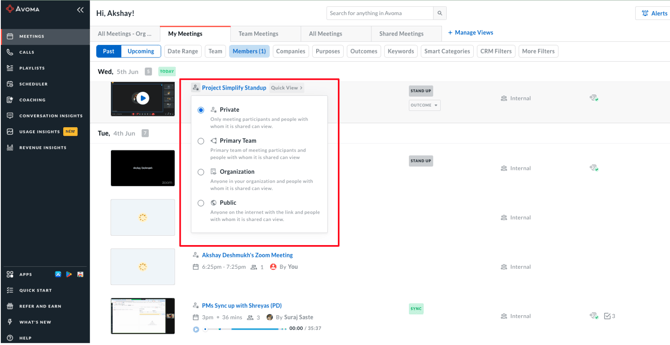
Private: Only participants and explicitly shared users
- Who can access
- People who were invited to or participated in the meeting.
-
- People the meeting is explicitly shared with (added manually).
- Who cannot access
- Other users in your org who were not participants.
-
- Admins do not get automatic access to other users’ private meetings.
- Default behavior
- All internal meetings are automatically set to Private.
- How internal private meetings behave
- If everyone in the invite list has the same work email domain (e.g., @yourcompany.com), the meeting is treated as internal.
-
- Examples: 1:1s, standups, internal project syncs.
-
- These meetings are visible only to
- The people on the invite, and
- These meetings are visible only to
-
-
- Anyone they explicitly share with inside Avoma.
-
- CRM behavior
- Private meetings do not automatically sync to your CRM.
-
- They can still be synced manually if needed.
What someone without access sees:
- If a private meeting link is shared with someone who doesn’t have access, they will see that the meeting is private and cannot view the content.
Primary Team: Participants + their main team
- Who can access
- People who participated in the meeting.
-
- Members of the primary team of those participants.
- Who cannot access
- Users outside those teams, unless the meeting is explicitly shared with them.
- Intended use
- This is useful when you need stricter, team-based access—for example:
- Regulated industries (e.g., healthcare with HIPAA-covered information).
- This is useful when you need stricter, team-based access—for example:
-
-
- Functions that handle confidential customer or financial data and must limit access to a specific group.
-
- Team requirements
- A user can belong to multiple teams, but only one is their primary team.
-
- For “Primary Team” privacy to work as expected.
- Each user must be assigned to at least one team.
- For “Primary Team” privacy to work as expected.
-
-
- Their primary team must be clearly set.
-
- Fallback behavior
- If a user’s privacy is set to Primary Team but they are not assigned to any team:
- Their external meetings behave like Private meetings.
- If a user’s privacy is set to Primary Team but they are not assigned to any team:
-
-
- That means only participants (and explicit shares) can see them.
-
Organization: Everyone in your org
- Who can access
- Any Avoma user in your organization.
-
- Plus, anyone you explicitly share the meeting with.
- Who cannot access
- People outside your company, unless they are given access via sharing or a public link.
- Default behavior
- All external meetings default to Organization visibility.
- How external meetings are identified
- If any attendee does not use your company’s email domain (e.g., @gmail.com, @customer.com), Avoma treats the meeting as external.
- Intended use
- Organization-wide access is useful when:
- You want to share the “voice of the customer” across teams.
- Organization-wide access is useful when:
-
-
- Sales, CS, product, and leadership need visibility into customer conversations.
-
-
-
- You want to make collaboration easier without opening access to the public.
-
- Relationship to other non-private meetings
- Any meeting that is not Private (e.g., Primary Team, Organization, Public) is considered more broadly shareable.
-
- “Organization” is the broadest level inside your company.
Public: Anyone with the link
- Who can access
- Anyone on the internet who has the meeting link.
-
- People the meeting is explicitly shared with.
- Who cannot access
- Only those who don’t have the link (there is no org-based restriction once it’s public).
- Default behavior
- No meetings are set to Public by default.
-
- Avoma prioritizes keeping meetings restricted to your org or specific people unless you deliberately choose otherwise.
- Intended use
- Use when you want to:
- Share a webinar, training, or demo recording with a broad external audience.
- Use when you want to:
-
-
- Avoid requiring logins for people outside your company.
-
- Safer alternative
- If you need to share with a small external group only:
- Keep the meeting non-public, and
- If you need to share with a small external group only:
-
-
- Explicitly share it just with those recipients instead of using Public.
-
2. Understand internal vs external meeting classification
How Avoma classifies a meeting (internal vs external) affects the default privacy level, though you can always override it.
- Internal meeting
- Every invitee has the same workplace domain as your organization (e.g., everyone is @yourcompany.com).
-
- Default privacy: Private.
- External meeting
- At least one invitee does not have your organization’s email domain.
-
- This includes generic domains like gmail.com, @yahoo.com, @outlook.com etc
-
- Default privacy: Typically Organization.
Note: The classification only affects the defaults. You can still manually switch a specific meeting to Private, Primary Team, Organization, or Public.
3. Special roles and how they see meetings
Guest users
- A Guest is a restricted role in Avoma with limited access.
- What Guests can access:
- Their own meetings.
-
- Meetings that are explicitly shared with them.
- What Guests cannot access:
- Other meetings in the organization that they were not a participant in and that were not directly shared with them, regardless of the broader privacy level.
- Participants always have access to their meetings, subject to:
- The chosen privacy setting, and
-
- Any additional sharing controls your org might use.
- They can also:
- Explicitly share individual meetings with specific users, which can grant access beyond what the global privacy level would normally allow (for that meeting only).
Avoma employees (Support/troubleshooting)
- By default:
- Avoma employees do not have access to your organization’s data.
- Optional support access:
- Admins can turn on a setting that allows Avoma employees to access your account only for troubleshooting and support.
-
- This is controlled by a security toggle in your Organization’s settings.
- When this matters:
- If you open a support ticket and want Avoma to investigate specific meetings, they may ask you (or an Admin) to enable this toggle.
-
- If the toggle is off, Avoma Support will not be able to view your environment or recordings, even if you request help.
Tips
- Use Private for sensitive internal discussions (e.g., HR 1:1s, performance reviews, leadership strategy).
- Use Organization for most external customer calls where the goal is internal visibility and learning across teams.
- Use Primary Team when:
- You operate in a regulated industry, or
-
- You want to restrict access to specific functional groups (e.g., a regional sales team, a clinical team).
- Use Public sparingly:
- Prefer explicit sharing for small groups over fully public links, especially if content includes customer-identifiable information.
Troubleshooting and FAQs
Why can’t someone in my organization see a meeting they expect to see?
This usually means the meeting is more restricted than they realize.
Check whether the meeting is set to Private. If it is:
-
They were not a participant, and
-
The meeting was not explicitly shared with them.
What to do:
-
Ask the meeting owner to:
-
Review the meeting’s privacy level, and
-
Explicitly share the meeting if access is appropriate.
-
Why do my external meetings seem more restricted than expected?
This often happens when Primary Team privacy is involved.
Check whether:
-
The meeting owner’s default privacy is set to Primary Team, and
-
The owner:
-
Is not assigned to any team, or
-
Has a very limited primary team.
-
What Admins can do:
-
Verify that users are assigned to teams and have a primary team set.
-
Adjust user or organization default privacy settings to better support collaboration.
Why can someone outside my company see a meeting unexpectedly?
This almost always means the meeting was set to Public.
What to check:
-
Confirm whether the meeting privacy is set to Public.
If it is:
-
Change the privacy to Organization, Primary Team, or Private.
-
Regenerate sharing links if your security policy requires tighter control.
-
For sensitive content, prefer explicit sharing over Public links.
Why can’t Avoma Support view my meetings when helping debug an issue?
By default, Avoma employees do not have access to your organization’s data.
This usually means the support access setting is turned off.
What to do:
-
An Admin can temporarily enable “Allow Avoma employees to access your account” in Organization settings.
-
Once enabled, Avoma Support can view your environment to troubleshoot.
-
After the issue is resolved, you can turn this setting back off.
What’s next
- Review your current usage of Private, Primary Team, Organization, and Public to ensure they align with your security and sharing policies.
- Confirm default privacy behavior for internal and external meetings.
- Set up or refine teams if you plan to rely on Primary Team access.
- Educate new users on:
- What each privacy option means, and
-
- When to choose each one in their day-to-day workflow.
- Set and manage meeting privacy settings in Avoma
Recap
Avoma’s privacy options—Private, Primary Team, Organization, and Public—control who can see each meeting and recording, based on meeting type (internal vs external), team membership, and any explicit sharing.
By understanding how each level works and how special roles like Guests and Avoma employees fit into the model, you can keep sensitive conversations protected while still making important meetings easy to discover and learn from.