
Before you begin
|
Step-by-step
Engagement tab: Understand conversation engagement
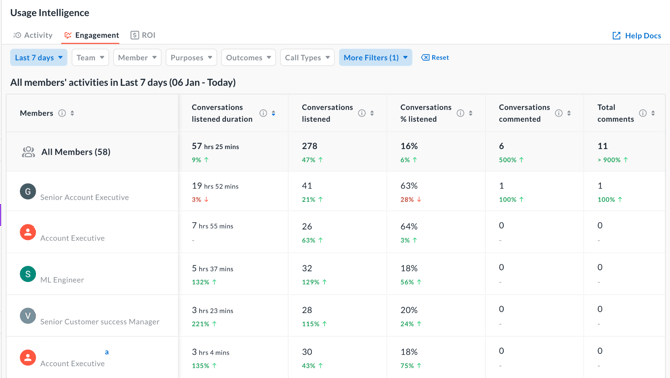
The Engagement tab focuses on what happens after conversations are recorded.
Access the Engagement dashboard
- Navigate to Usage Intelligence.
- Select the Engagement tab.
- Use the default timeframe (for example, Last 7 days) or adjust it as needed.
Review top-level engagement metrics
- Review the aggregated engagement metrics at the top of the table:
- Conversations listened duration – total time users spent listening to conversations.
- Conversations listened – number of conversations that were listened to.
Conversations % listened – percentage of available conversations that were listened to.
Conversations commented – number of conversations that received at least one comment. - Total comments – total number of comments added.
- Green and red arrows indicate change compared to the previous period.
Understand engagement by member
- Review the table to see engagement at a member level:
- Members – team members who listened to or commented on conversations.
- Conversations listened duration – total listening time by the member.
- Conversations listened – number of conversations the member listened to.
- Conversations % listened – percentage of conversations available to that member that were listened to.
- Conversations commented – conversations where the member added comments.
- Total comments – total number of comments added by the member.
Use filters to refine engagement data
- Use filters at the top to narrow insights:
- Timeframe
- Team
- Member
- Purposes
- Outcomes
- Call Types
- More Filters (for advanced criteria)
- Combine filters to answer questions such as:
- Are reps reviewing their own calls?
- Are managers listening and commenting on team calls?
- Which call types receive the most follow-up engagement?
Interpret trends and changes
- Use the percentage change indicators to understand trends:
- Green arrows indicate increased engagement.
- Red arrows indicate reduced engagement compared to the previous timeframe.
- Focus on sustained trends rather than short-term spikes to evaluate adoption.
Tips
- High conversation volume with low engagement often signals coaching or enablement gaps.
- Use Conversations % listened to compare engagement fairly across roles and workloads.
- Encourage managers to leave comments to drive consistent review behavior.
Troubleshooting and FAQs
Why is Conversations % listened low even though many conversations exist?
This is expected when conversations are recorded but not reviewed.
- Check if users know where to find recordings.
- Confirm coaching or review expectations.
- Look at engagement by role or team.